In recent years, the Posts and Telecommunications Institute of Technology (PTIT) has consistently established its position as one of the leading information security training centers in Vietnam. Not only does PTIT have an updated curriculum based on international standards, it also has built a modern virtual practice environment, a vibrant CTF competition culture and extensive network of corporate partnerships.
On the occasion of the PTIT team’s outstanding win of First Prize in the 2025 Cybersecurity Student Competition, also on Vietnamese Teachers’ Day, November 20, Vietnam Cyber Security Magazine held a talk with Dr. Nguyen Ngoc Anh. Ding Truong Duy – lecturer in the Department of Information Security. The conversation revolves around the training philosophy, the team’s journey, and expectations for the new generation of Information Security engineers amid the changing technology.
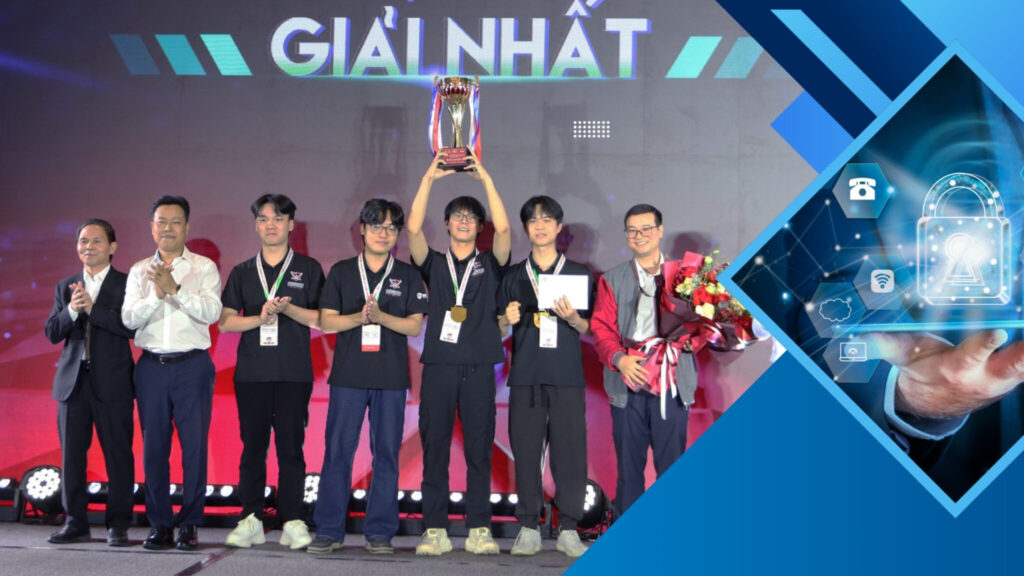
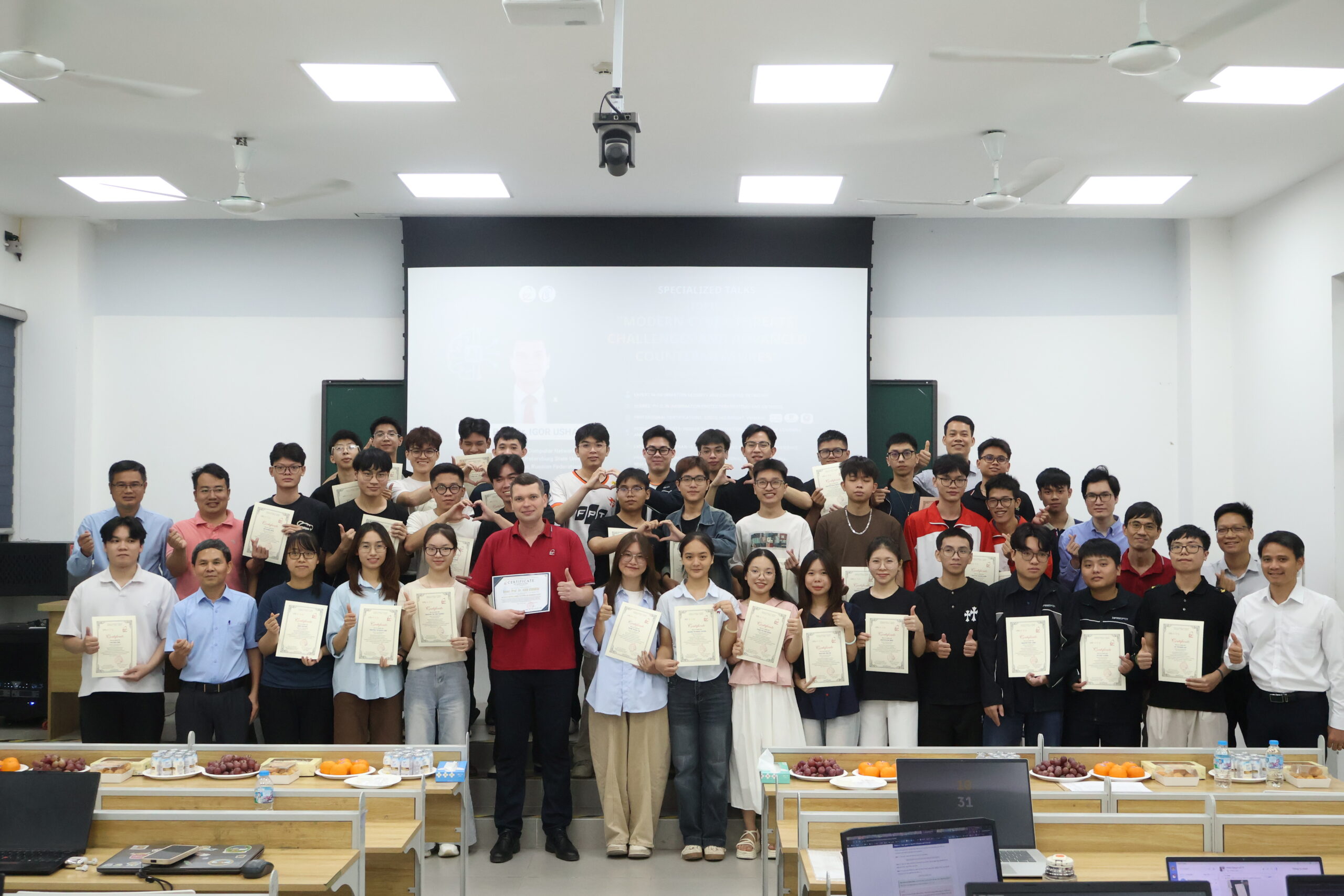
PTIT team teacher and student won First Prize at the 2025 Information Security Student Competition
– Congratulations to you and the PTIT team for winning First Prize at the 2025 Students for Information Security. PTIT has been known to have high – performing students in the cybersecurity playing fields for years in a row. YOUTH: What is the strength of the Academy’s training in order to improve safety?
– Ting Truong Duy: In my opinion, there are three pillars that make up the strength of PTIT in the area of safety training:
Firstly, the Academy shall formulate a training program which is capable of meeting international standards and closely associated with the practical requirements of the safety sector, which helps students to have a firm foundation. For example, PTIT’s new safety and information sector program, issued in 2025, emphasizes in – depth knowledge, practice, and soft skills.
Second, the learning and training environment is designed to be open. Students of the Faculty of Information Security practice on a virtual information security practice system, where they are trained with hundreds of exercises designed by the faculty’s teachers. Because of the business – school – faculty cooperation, students have more opportunities to participate in the field through competitions, workshops, and internships in safety. From there students are not only learning theory but being trained in the context of reality.
Thirdly, the “emulation – conquest” culture is encouraged: teams, clubs, laboratories are supported, motivated and have mechanisms for students to show competence, to take on challenges. When they see you first, they’re motivated to move on.
By combining good programming, real – world environments, and academic – exam culture, PTIT has repeatedly achieved success on cybersecurity playing fields.
– What is the orientation of the Faculty’s current safety training program to meet the practical needs and rapid technological change?
– The training program in the field of traffic safety of the PTIT is oriented according to the following highlights:
First, the department has perfected the program towards international accreditation standards and constant updating in the face of rapid technological change, especially as AI, online fraud and new methods of attack increase drastically.
Second, it must be associated with the practical demands of the safety sector. The new program, released in 2025, has three disciplines: Network Security, Blockchain and Applications, Digital Forensics.
Third, diversify training routes to develop elite human resources. In addition to standard training, the Department of Education and Training (PTIT) has implemented training: the talented student system and the high quality system. The talented student system shall provide elite-oriented and intensive training, intensify research, conduct advanced researches and courses and participate in practical projects. With high-quality systems, specialized subjects will be taught in English, attaching importance to the development of deep-practice capacity and technology mastering capacity with many lab hours and seminars with enterprise experts.
Fourth, flexibility to adapt quickly to changing technology. The program uses a credit – based institution, with extensive and open options, to help students stay up – to – date with new cybersecurity techniques and models.
– Can you share the teaching methods, lab models, or experiential activities that your department is using to increase student engagement?
– Faculty has built an Information Security Digital Practice System with hundreds of virtualized labs. The system allows students to: Practice 24/7 in a safe, independent, virtual environment; Experiment with more than 200 labs on a variety of topics: vulnerability exploitation, systems, web, malicious code, network analysis, etc.; Automatically collect scores, grade and provide quick feedback, helping students identify weaknesses and improve their skills immediately.
The Faculty also regularly invites experts from businesses to exchange information through professional seminars; moreover, the Faculty is associated and cooperated with many organizations and businesses in the field of information security – providing a favorable environment for students to practice and experience the working environment as well as practical projects.
In addition, the Faculty has built an Information Security Club and internal competitions: The PTIT CTF is the annual information security competition organized by the Faculty and is a rewarding playground for PTlTs who love information security.
– The PTIT team excelled in winning First Prize in the 2025 Cybersecurity Student Competition. Can you share the team’s preparation from inception to the finals?
– The PTIT team is formed on the basis of members of the information security club and high – ranking PTlT CTF competitors. The members of the team are qualified students who are passionate about safety and are willing to practice seriously. We continuously organize training for our students, starting with the consolidation of background knowledge and then moving on to training in CTF, Attack – Defense, lab construction, attack – defense simulations with the help of PTIT and SAT alumni as well as the professionals invited by the department. The team is also constantly being trained through online as well as offline tournaments at home and abroad.
This year’s competition has many new points compared to the previous years, the team has carefully analyzed the requirements of the competition to come up with the most appropriate strategy. After qualifying with two teams in the top 10 of over 350 teams, the teams immediately focused on the category they would compete in the finals through specialized seminars with experts as well as the continuation of other CTF competitions of similar format. This will give you maximum confidence for the finals.
– What was your feeling the moment the team was named first place?
“When the name of the PTIT team came out and the First Prize was awarded, I felt so proud and excited and excited. Proud of the silent efforts of many years, moved by the sight of the students — the vibrant young people — shining, and excited by the “we can do it.”
It’s not just their own achievement, but it’s also a testament to the training environment, the support of the Academy, and the faculty of the school. This is a milestone so we can see our mission clearly.
– During the competition, did I remember the situation the most, whether it was a technical error, a “cranial” processing, or an interesting thing from the students themselves?
“What I remember most was how the team handled the coin management tactics of the competition. At one point the PTIT team fell out of the Top 1 for a few rounds, but they didn’t lose their cool. From the very beginning of the competition, the team calculated in great detail its own and competitors’ coins, as well as the rule of increasing – decreasing the cost of buying an advantage round by round.
Thus, when temporarily down, the team actively does not use early coins but keeps the final rounds – where the score coefficient is higher. This strategy allows the team to accelerate at the right time. At the end of the competition, PTIT was down to five coins, which was almost optimal, while many teams still had several hundred coins but failed to change their rankings.
That phase shows your mastery and strategic thinking: mastery and assertiveness, not just technical mastery.
– YOUTH: How do you assess the change in the current generation of students who are doing well in school as compared to the past? What impressed you the most?
Compared to before, I see the technical ability, the level of initiative and the speed of learning of students now exceed very much. In the past, many of you in the cybersecurity industry were afraid: “what is the network,” “how is the governance of the system,” and “can I follow it?” But now young people have entered the industry thinking, “I’ll do it,” willing to read foreign documents, test labs, join the CTF from the first year.
What struck me most: the ability to be self – taught and self – in – operation — to not just follow the lessons but to explore, to explore new holes, to be part of the community, to speak English, to do demos and be ready for action. For example, a first – place team member who was selected by the ASEAN Cyber Shield (ACS) to participate in the ACS South Korea information security bootcam due to his excellent performance during the course, which is an online course in English.
In addition, students are now active in team, club, hackathon, and early – practice businesses — a welcome development that shows that the safety – information sector is no longer “reading – learning theory” but is actually a real – life and challenging profession.
– What is the hardest thing for you in your teaching career, and how often do you get through it?
– The hardest thing is to keep motivated, active and consistent with the pace of technological change for each student. Because security is a very rapidly changing field: new vulnerabilities, new technologies, new attack patterns. If faculty and the curriculum do not keep up, students will be “missing” reality.
It’s important to stay up – to – date, such as at conferences, doing research, working with businesses, and bringing new situations to the classroom. In addition, I also tried to create a learning culture that encouraged students to ask questions, to discuss, to learn by themselves, without fear of making mistakes. When they’re ready to “break their own mistakes” and move on, the hard part is much less.
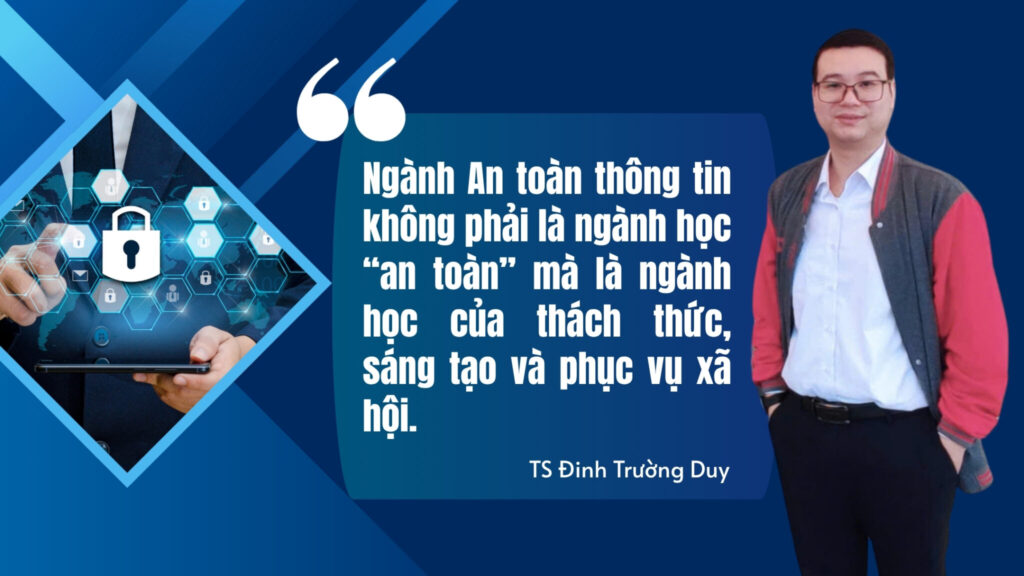
Professor Đinh Trường Duy – PTIT Department of Information Security
– If teaching is like a long – term cyberdefense, how do you think the role of the teacher in the AI age has changed?
I strongly agree with this view: the education profession in the age of AI becomes more like a “strategic cyberdefense”: not only to consolidate a solid knowledge base but to always anticipate, update, detect, and address new gaps – in this case, gaps in thinking, skills, and technology fit.
So I think the role of the information security instructor is therefore going to change in three ways.
Guide: rather than just giving lectures, faculty became guides to students in a “lifetime learning” environment, because AI can support knowledge, but humans still need critical thinking, creativity, and professional ethics.
The Architect of Experience: With AI and technology coming fast, teachers have to design real exercises, labs, projects — places where students don’t just passively learn, but engage, experiment, make mistakes, correct errors, improve.
Applied and Ethical Improvement Professionals: In the AI era, the risks of security, privacy, automatic attacks, deep-fake…are greatly increased. Therefore, the lecturer must instill not only “do it” but also “do the right thing”, which is socially responsible.
So, in the AI era, the education of cybernics doesn’t retreat into the lecture halls, but into the center of realism, innovation and the future.
– As a teacher and a direct instructor in major competitions, what do you expect from PTIT’s next generation of safety engineers over the next 5 to 10 years?
I set three big expectations.
Number one, you will not only meet your domestic needs, but you will also reach out to the world: to join the regional and global cybersecurity arena, to develop your own skills, to take ownership of your technology.
Second, you will be full – blown combat experts — not just exploiting and defending, but also implementing, operating, evaluating, and innovating new security solutions because PTIT’s training program designed the outcome.
Third, you will be leaders, innovators and ethically responsible in the context of digital transformation, and cybersecurity is a national strategic area. I hope you’re not just engineers, but leaders, innovators, influencers and socialists.
If this is achieved, in the next 5 – 10 years PTIT will have “leading experts” in the security industry, from teachers, experts, security start – ups to business leaders, and thus will contribute to maintain PT IT as the “hub” of outstanding cybersecurity students.
– Finally, what would you like to say to students on Teacher’s Day, November 20, especially those who have ambitions to pursue a career in safety?
On the occasion of November 20th, I would like to say to my students, “Keep the fire of enthusiasm and passion in your heart. Information Security is not a “safe” discipline but a discipline of challenge, creativity, and social service.
Embark on a journey: learn English, learn programming, learn networking, learn security, join the CTF, join a team, take on a reality project. Don’t be afraid to make mistakes, do n’T be afraid of failure — every mistake is a lesson and a win.
Remember: at PTIT you’re not just trained in knowledge, you’ve been given opportunities. Turn that opportunity into action. And if you are today a “small student,” tomorrow you will be “a big expert,” a Vietnam cyber security guard.
Thank you for choosing this course, for choosing PTIT, thank you for having me and the Academy with you. Good luck studying, competing well, and writing your own success stories soon! ”
– Thank you and wish you to train more AT&T experts to meet the country’s human resources needs in the future!
Source: https://tcanninhmang.vn/su-kien-quan-diem/202511/nghe-giao-an-toan-thong-tin-khong-lui-vao-giang-duong-ma-buoc-vanao-trung-tam-thuy-chien-dcf465a/
(According to ptit.edu.vn)
NPM
POST AND TELECOMMUNICATIONS TECHNOLOGY SECURITY SCHOOL (PTIT)
 Address: 10th Floor, Building A2, Posts and Telecommunications Technology Academy,
Km10, Nguyen Trai Road, Q. Ha Dong, Hanoi
 Website: https://infosec.ptit.edu.vn
 Email: attt@ptit.edu.vn
 Fanpage: facebook.com/KhoaATTT.PTIT